


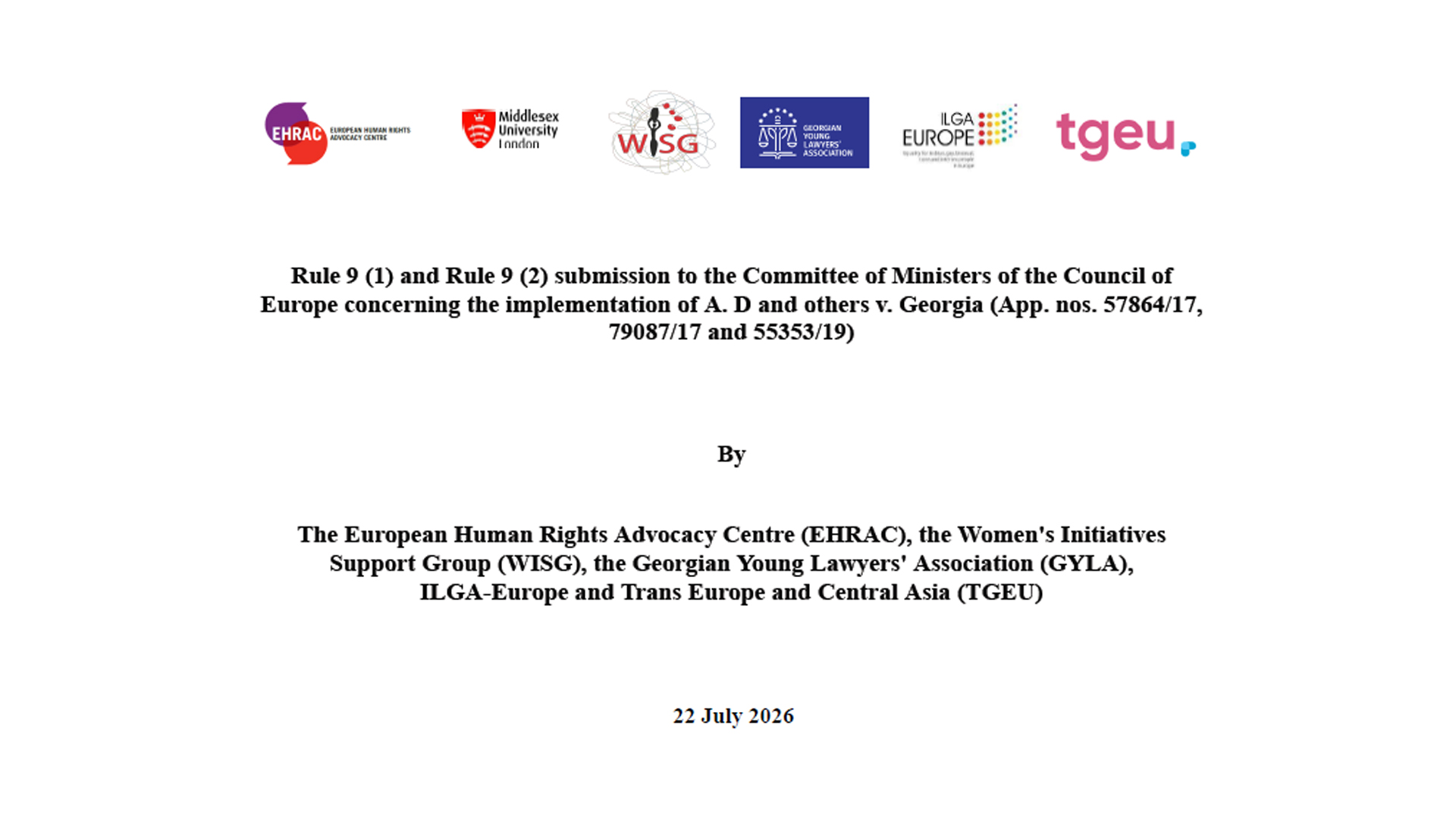
This submission is made in advance of the Committee's examination of the case of A.D. and Others v. Georgia at its 1569th meeting (September 2026) (DH) and responds to the Government's Action Report of 29 June 2026. More than three years after the judgment became final, none of the three applicants has been afforded legal gender recognition. The 2024 Law "On the Protection of Family Values and Minors" continues to prohibit such recognition, bars the domestic courts from giving effect to foreign recognition decisions, and has thereby rendered restitutio in integrum legally impossible. The Government's Action Report provides no new information on individual measures, referring the Committee back to the Action Plan of April 2025, and reiterates in substantially identical terms the assertions concerning the absence of European consensus and the primacy of national values which the Committee implicitly rejected in its decision of September 2025. The submission of an Action Report, an instrument by which a State is meant to report on progress made, in circumstances of clear total non-implementation and further regression is itself indicative of no intention to comply.
The introduction of the absolute ban on legal gender recognition is not only the product of legislative inertia but clearly reflects a targeted state policy of the highest State organs, as confirmed by the public statements of the Prime Minister, the Speaker of Parliament and the Chairman of the Legal Issues Committee, and by the Government's own written response to the OSCE Moscow Mechanism report. That posture reproduces the pattern of rejection of the Court's findings condemned by the Grand Chamber in Ilgar Mammadov v. Azerbaijan and is incompatible with the unconditional obligation under Article 46 § 1. The violation has, moreover, been entrenched and aggravated: protections based on gender identity have been dismantled, gender-affirming healthcare criminalised, and the civil society organisations supplying the Committee with information now operate under threat of criminal liability. The signatory organisations accordingly invite the Committee to schedule the case for its earliest examination and to adopt an interim resolution recognising the refusal to execute the judgment and the Committee’s intent to consider stronger measures, urging the immediate amendment of the applicants' records, the repeal of the relevant provisions of the “Family Values Law”, and intensified engagement with the Georgian authorities by all other member States.
Read the full submission